


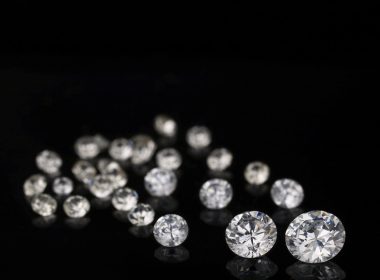
The loose diamond certification process is an easy way to boost buyers’ confidence during the shopping process. When diamond certification is conducted by a reputable organization, such as the Gemological Institute of America (GIA), buyers can rest assured that the diamond is a genuine, natural diamond, rather than grown in the lab as a synthetic diamond. It also reveals whether or not a loose diamond has been treated.
Since no two diamonds are alike, the certification process assigns value to each individual stone. For example, the GIA uses an internationally recognized grading system to compare common attributes. This system, known as the “four C’s”, determines each certified diamond’s value by grading its color, clarity, cut, and carat weight.
Diamond Color
To determine the color of a diamond, a gemologist compares the stone to a color classification chart ranging from D (colorless) to Z (light yellow or brown). The loose diamond is compared to a set of master stones representing the colors on the chart.
Certified diamonds classified as “D” are colorless, while those graded “Z” are light yellow or brown. Since truly colorless diamonds are extremely rare, the majority of diamonds used in jewelry are designated as “H” or “I” and have a slightly yellow tint—described by gemologists as “nearly colorless”.
Diamond Clarity
Natural diamonds are formed under considerable heat and pressure, giving most of them internal or external inclusions that can impact diamond clarity. There are eleven grades of diamond clarity, ranging from flawless (no inclusions visible under a magnifying glass) to I3 (inclusions visible to the naked eye).
Much like the human fingerprint, inclusions are markings that distinguish one loose diamond from the next. During certification, gemologists plot a diamond’s inclusions on a diagram to indicate its distinctive features—those that no other diamond has—which then get added to the certification paper. This diagram helps match each diamond to the proper certification, so buyers can be sure the diamond they’re evaluating is the same one on the report.
Clarity tests also reveal authenticity, helping gemologists determine whether a diamond has been treated. Inclusions verify that a diamond is natural, rather than a synthetic look-alike. If it is determined that a diamond has been treated, that will be noted on the certification report.
Diamond Cut
While people often think of cut as indicating the shape of a diamond (i.e. square or round), the term is used during certification to describe the stone’s sparkle and brilliance on a range from “Excellent” to “Poor”. To assist with cut grading, gemologists place each loose diamond in a machine, rotating the stone 360 degrees and capturing every one of its facets to generate a sophisticated 3D model. Many factors are considered to determine the stone’s grade, including proportions, girdle thickness, culet size, polish, and symmetry.
Diamond Carat Weight
As counter-intuitive as it might seem, bigger isn’t always better when it comes to diamonds. Value is determined by all four of the “C’s”, not just its weight.
To determine carat size, certified diamonds are placed in high-tech, sealed-chamber electronic scales. The weights, which measure how close a diamond is to one carat (200 milligrams), round each stone to a second decimal place to arrive at a standard carat size measurement.
Upon completion of the rigorous certification process, a certified diamond is given a report indicating its grading for each of the four C’s, along with other pertinent information. Buyers can ask to see this report before purchasing a certified diamond; some grading agencies also allow them to check the information online.
Want to learn more about how to certify diamonds? Watch the video below, which chronicles one diamond’s certification journey at the Gemological Institute of America (GIA).
Black diamonds, or carbonados, are one of the many diamond varieties found in the earth’s surface. Unlike conventional diamonds, which are mined in a variety of locations throughout the world, carbonados have only turned up in parts of Brazil and the Central African Republic. They are also believed to be a couple billion years older than their more commonly known white and colored counterparts.
These unusual grey and black stones get their opaque coloring from high concentrations of impurities and inclusions, such as graphite. In their rough form, carbonados resemble small rock pieces of cast iron or porous charcoal.
Tougher than a Diamond
While loose diamonds are legendary for being impossible to crack, carbonado has gained a reputation for being even stronger. While other diamonds are composed of a single crystal that breaks naturally along a line, a carbonado is made up of many crystals that are fused together. Its stronger structure made it popular in heavy industry since its discovery in the late 1800s.
Black diamonds from Brazil were instrumental in early rock-boring efforts, providing key drill tip components for carving out the Panama and Suez canals, as well as tunnels all over Europe. Carbonado is still used in drill bits for tough jobs today, cutting through rocks that even traditional diamonds would have trouble cracking.
Polished to Perfection
Polished and cleaned up from their original carbonado state, black diamonds can enhance jewelry designs by making a dramatic, yet elegant, statement in both women’s and men’s fine diamond jewelry. Whether framed in sterling silver, brilliant white gold, or yellow gold, a black diamond makes any foundation’s surface come to life with a brilliant shine.
A black diamond creates a dramatic centerpiece for an eye-catching pendant, ring, or for earrings, while smaller baguette-style black diamonds serve as elegant backdrops for sophisticated and delicate settings. When set in white gold and paired with lighter stones or pearls, dark accents of black diamonds add an air of sophistication and timeless quality to even the simplest jewelry piece.
Surprisingly Affordable
Their elegant appearance often leads people to believe that black diamonds are expensive. Thanks to industrial use and heavy demand for clearer stones, however, black diamonds haven’t taken center stage in the global marketplace. Less notoriety and demand actually makes this type of jewelry far more affordable than people think.
Equally misleading is the black diamond’s perceived rarity. Though unearthed in few places, uncertified and certified black diamonds are readily available to customers. Loose black wholesale diamonds can be purchased and turned into custom jewelry pieces at an attractive price, making the black diamond a unique and affordable option for high-end jewelry.
Diamonds, fine jewelry, and engagement rings are prized possessions and it important to protect your purchase with jewelry insurance. Although every order from Brilliance is fully insured during shipment, the responsibility for your purchase is transferred to the customer upon arrival at your address. Jewelry insurance can be purchased through your homeowner’s or renter’s insurance, or can be bought separately through a specialized jewelry insurance company.
Most homeowner’s and renter’s insurances automatically include coverage from between $500 to $2,500 for all jewelry items within the home. One option is to add your jewelry or diamond purchase to your homeowner’s and renter’s insurance as an additional item to protect you in the event of theft. However, these policies do not always protect against other events such as loss or damage. Additionally, they may only cover a portion of the value of your jewelry or have certain policies that you need to be aware of such as deductibles, source for replacement, coverage amount, and others. If you select this method of insurance, it is important you ask questions regarding these policies and be knowledgeable of your coverage.
The option that offers the most protection is to add a rider to your homeowner’s or renter’s policy. Before insuring your purchase, the insurance company will request a gemological appraisal, which is a document that provides a detailed description of the item to be insured as well as the replacement value of the item. Gemological appraisals are usually conducted by an expert jeweler or gemologist and can cost between $50-$250. As a unique service to you, Brilliance provides a free gemological appraisal certified by our Master Gemologist with every purchase. This option guarantees enough coverage for your jewelry or diamond. Keep in mind that the coverage rates are often negotiable.
If you do not want to add a rider to your homeowner’s or renter’s policy, or do not currently have insurance, you can also purchase insurance through companies like Jeweler’s Mutual or The Chubb Group that specialize in protecting prized assets like fine jewelry or engagement rings. These companies will also require a gemological appraisal prior to insuring your purchase. Jeweler’s Mutual policies generally cover loss, theft, mysterious disappearance, and damage. Additionally, with Jeweler’s Mutual, you get to work with the jeweler of your choice and not through a dictated replacement company, as other companies require. However, a policy through Jeweler’s Mutual does not usually cover unset stones or loose diamonds. The Chubb Group offers a policy that covers personal valuables such as jewelry. This company has an insurance option that provides full coverage for the itemized amount shown on the policy without deductibles. Additionally, this insurance covers loss and theft world-wide. In addition to the option of replacing your jewelry item, Chubb also allows you to receive a cash settlement instead of replacement. An appraisal is recommended for jewelry insurance and required for items valued above $50,000.
Any insurance company will recommend that you have your jewelry inspected and appraised often to prevent potential losses and to update the replacement value of your items. Brilliance offers this service free of charge to our clients twice a year with our care and maintenance program. You can send your Brilliance jewelry to us for free inspection, cleaning, polishing, and refinishing. This way you will keep your jewelry looking like new and your diamonds set securely to help prevent a loss. Additionally, an updated appraisal can be issued to our clients upon request.
A Brilliance representative can explain your insurance options and can assist you in the process of insuring your purchase. Upon request, we can also fax your jewelry appraisal to your insurance company prior to shipment so that your purchase is insured upon arrival to you. Contact a Brilliance representative at 866-737-0754 to get started.
Are you considering buying EGL diamonds? If so, is the diamond grading report issued from EGL International or EGL USA? When purchasing an EGL certified diamond, it’s important to understand the fundamental differences between these organizations.
In 1973, Guy Margel opened the first European Gemological Laboratory (EGL) in Antwerp, Belgium. Today, EGL International has a presence in all major diamond sourcing cities in the world, including Antwerp, Johannesburg, Paris, London, Tel Aviv, Seoul, Istanbul, Mumbai, Delhi, and Cape Town. Each of the EGL facilities is an independent franchise operating under the EGL International brand.
Originally, EGL USA was a franchisee of EGL International. In 1986, it became independent of the European organization, and today operates as a completely separate company. Headquartered in New York City, EGL USA has laboratories in Los Angeles, Vancouver, and Toronto.
Grading Differences
Diamond grading is a subjective skill. When these skills are put to the test at laboratories maintaining independent diamond grading standards, it’s no surprise that there are sometimes discrepancies. EGL International maintains 10 independently owned and operated testing facilities around the world, while EGL USA’s three laboratories are owned and operated collectively as one entity. This means that EGL USA is able to maintain much more uniform and rigorous standards than EGL International.
Generally speaking, EGL International diamond grades are more lenient than those issued by EGL USA. As a rule of thumb, EGL USA certified diamonds are comparable to EGL International certified diamonds that are graded one color grade and one clarity grade higher. For example, an EGL USA diamond that’s graded H in color and SI1 in clarity would be graded as G and VS2 by EGL International.
Choosing an EGL Certified Diamond
Approximately 23% of certified diamonds sold on the Internet are EGL-graded. When purchasing one of these diamonds, be sure to look for a diamond report with an EGL USA logo. This report will state, “Member of the EGL USA Group”, with certificate numbers preceded by either US (United States) or CA (Canada).
Currently, EGL USA is attempting to stop the import of loose diamonds with EGL International reports. Diamond reports issued by European labs have a universal report with the country of origin printed on the cover card. Each European lab has its own numbering or lettering convention, as outlined in the examples below:
EGL Belgium: Alphanumeric characters; certificate code begins with A
EGL South Africa: Begins with SA
EGL Turkey: Begins with T
EGL India: Begins with letters D – J; maximum of 9 digits
EGL Israel: Usually begins with a number 2
If you’re purchasing an EGL-graded stone, keep in mind that EGL USA has tighter grading standards – especially with regard to diamond color and clarity. However, there’s no guarantee that all EGL USA certified diamonds are better than those certified by EGL International. Although the EGL International’s looser grading standards have made their certification slightly less credible, they have also caused the prices of EGL International certified diamonds to be lower in the diamond market. Therefore, you can sometimes get a great bargain for an EGL International certified diamond that has been under-priced.
When in doubt, it’s a good idea to consult with an experienced jewelry and diamond professional before making your purchase. Contact a Brilliance diamond expert at 866-737-0754 for guidance on which diamond certification is right for you.
Many people approach buying loose diamonds by just walking into their local jewelry store, but there’s actually lot to think about in order to make an informed decision. The people behind Brilliance.com make it their goal to educate customers all about certified loose diamonds and diamond jewelry. Doing this ensures customers are getting the very best certified diamonds available on the market and the highest quality customer service. Because of Brilliance.com’s dedication to quality and customer service, the diamonds they offer are certified by some of the most qualified and well-respected laboratories in the world.
Laboratory Certified Diamonds
What’s the difference between laboratory certified diamonds and uncertified loose diamonds? It’s easy – laboratory certified diamonds have been graded by a trained gemologist. The gemologist will note all the important details about the diamond, including the cut, carat weight, clarity and color. The professional gemologists will be able to discover any flaws, determine the color, weigh the diamond and evaluate how well the cut maximizes the diamond’s brilliance and fire.
Each stone is graded objectively, regardless of who is grading the diamond. Sometimes more than one gemologist grades each stone to ensure accuracy. Since the world of certified diamonds is a small one, some laboratories even hide the name of the diamond’s owner, allowing the gemologist to grade the stone without bias.
What Can You Expect From Brilliance.com’s Certified Diamonds?
You’ll be sure to find quality diamonds if you’re shopping at Brilliance.com. If you’re shopping for certified diamonds, you can easily compare diamonds of similar sizes, cuts and price ranges. This means you can purchase the best quality diamond regardless of how small or large a budget you have available.
Certified diamonds from Brilliance.com are sold with a detailed grading report. If you’re looking for diamonds from other sources, make sure you’ll receive the grading report along with the diamond. A reputable store selling certified loose diamonds should expect to include this information with your purchase. If they can’t provide it, take your diamond shopping elsewhere.
Trust Only The Best Diamond Laboratories
There are many laboratories that grade certified loose diamonds, but Brilliance.com only chooses to use the very best. These laboratories are the International Gemological Institute (IGI), the European Gemological Laboratory (EGL), the Hoge Raad voor Diamant (HRD), the American Gem Society and the Gemological Institute of America (GIA). Each laboratory uses different methods, but all are considered top sources of certified loose diamonds.
The AGS grades diamonds on a 0-10 scale, with 10 being the worst and 0 being the best. Two different gemologists grade each stone, and the laboratory is known for having some of the industry’s highest ethical standards.
The HRD, located in Belgium, is well respected in the world of certified loose diamonds. The HRD requires that several gemologists grade each stone and the results must be identical before the stones can be considered certified diamonds. Additionally, the HRD has two more steps to ensure graders are completely unbiased. Firstly, gemologists never know the identity of the diamond’s owner. Also, senior gemologists randomly check the certification paperwork against the stone to make sure the diamonds are being accurately graded.
The EGL is also based in Belgium and is known industry-wide for setting new standards in certified loose diamonds. At one time, loose stones under one carat weight weren’t even considered for grading. Now, many of Brilliance.com’s certified loose diamonds are less than one carat, which shows the influence the EGL has in the diamond world. Recently, the EGL created the SI3 grade, which means a stone has visible inclusions under a 10x magnification.
The IGI ensures accurate grading of loose diamonds by using a team of gemologists to grade each stone and some of the most advanced equipment available. The equipment used by the IGI includes an electronic balance that can accurately measure the diamond’s weight to a ten-thousandth of a carat, 10x magnification loupes and high-powered microscopes. The entire team must agree before a stone can be graded.
The Best Of The Best – GIA Loose Diamonds
The GIA is considered the best of the best in the world of certified loose diamonds. The GIA was founded in 1931 and created the International Diamond Grading System in 1953. The International Diamond Grading System sets uniform criteria that graders use when certifying a diamond. Additionally, each GIA certified diamond is graded by two to five different gemologists to ensure accuracy.
Many different gemologists must agree on a diamond’s certification before it can be given a GIA grading report. The report will give the culet and girdle thickness, the weight, color, clarity, measure, polish, symmetry and even a diagram that tells the buyer exactly where any inclusions are located. The written report should be included when you buy certified diamonds.
Buying certified diamonds, whether loose or pre-set into a piece of jewelry, means you’ll be purchasing a beautiful, quality product that’s sure to provide years of enjoyment for the wearer. After reading up on the different laboratories that offer certified diamonds, you can rest assured that you’re buying diamonds from a reputable source when you shop at Brilliance.com.
A groom shares his tips on buying an engagement ring, including information on solitaire settings and other diamond engagement ring styles, diamond carat, diamond color, diamond clarity, and certified diamonds. As he explains in the video, “Planning a wedding has been an education. Everything from the ring buying to the holidays has been overwhelming, so I’ll try to help you with the things I’ve learned along the way.”
Customizing your beloved’s engagement ring is not only a growing trend, but also a process that can be quite enjoyable. When looking to give your loved one something uniquely customized, one has to look no further than examples already set by famous celebrities such as Princess Diana and Britney Spears who enjoyed custom engagement ring designs. Additionally, a custom engagement ring’s style can be inspired by the latest designers, including Jack Kelege, Harry Winston and Scott Kay, at a fraction of the price. At Brilliance.com we can help you design and create the perfect engagement ring as well as find the loose diamonds to complement your unique style.
Designing Your Own Custom Engagement Rings
In designing your own engagement rings you can create a ring that is truly one-of-a-kind. People often choose to design their own engagement rings due to not being able to find the perfect ring already on the market. Customizing your own ring allows you to integrate design elements you prefer within currently existing rings, combining them into your own unique style. If you want to keep your design exclusive, ask your jeweler whether they duplicate designs. This can assure you that your custom engagement ring for your beloved will never be re-created.
Custom Engagement Rings and Metals
Custom engagement rings can utilize standard metals such as Yellow Gold, White Gold and Platinum, but can also have more exotic metals such as Palladiam or Rose Gold. Palladium has been used as a precious metal in jewelry since 1939 and is an alternative to platinum or white gold. Its popularity is due to its naturally white properties, giving it no need for rhodium plating. Palladium is slightly whiter than platinum and about 12 percent harder.
Palladium is one of the three most popular metals used to make white gold alloys. Palladium-gold is a more expensive alloy than nickel-gold, but seldom causes allergic reactions. Nearly as rare as Palladium is Platinum. Platinum will not oxidize or decay over time and is naturally white in color. Its scarcity makes it highly prized, but its demanding nature also means that only the most skilled artisans can work with it. A single ounce of platinum not only requires exceptional effort to mine and refine, but it also involves weeks of expert handling to craft into a piece of jewelry.
If you like something more traditional, you may consider yellow or white gold. Gold is the metal that never goes out of style. Depending on your color preference, gold’s yellow tint may be a choice to inset your diamonds. If you love gold but prefer the color white, there is of course the option of white gold. The color of gold jewelry is determined by alloying other metals to pure 24kt gold. Yellow is the most natural, warm and sensual color. For a more elegant appearance, white gold is created by alloying pure gold with zinc, palladium and silver. Gold’s purity is measured in karats and 24kt gold is the most pure at 100%. This class of gold is rarely used in practical jewelry creation given its malleable nature, therefore 18kt gold, which is 75% pure and 14kt gold, which has almost 60% gold content are the most commonly used when creating fine jewelry.
Rose gold is a gold and copper alloy widely used for specialized jewelry due to its reddish color. The highest carat version of rose gold is also known as crown gold, which is 22 carat. An 18 carat rose gold may be made of 25% copper and 75% gold. For 18 carat rose gold, typically about 4% silver is added to the 75% gold and 21% copper to give a rose color. At Brilliance.com we can provide you with any of these types of metals to help you design engagement rings that will be treasured.
Finding The Perfect Loose Diamonds For Your Ring’s Design
Shopping for loose diamonds for your engagement ring requires only a little insight and information to ensure that you find the perfect diamond for the best price. Three critical criteria in evaluating how to choose the right loose diamonds are certification, the 4 C’s, and asking about diamond enhancements.
Certified loose diamonds are diamonds that have been evaluated by an independent lab where they are measured and weighed as well as evaluated for width, length, table and girdle sizes. Diamonds are also at this time graded and assigned a color and clarity grade. Brilliance.com prides itself in selling only certified loose diamonds.
The value of a diamond is based on the 4 C’s of the diamond industry: Cut, Color, Clarity and Carat Weight. Because these elements are critical to the value of a diamond, one wants to steer clear of what is called diamond enhancements. If diamonds have been enhanced, the seller of the diamond must inform you of this. Diamond enhancements include clarity treatments, laser drilling to remove inclusions, application of sealants to fill cracks and color treatments to improve a white diamonds’ color grade.
At Brilliance.com we realize that people who design their own custom engagement rings find that the flexibility and choice make it all worth the while. Armed with information and ideas, you can create the perfect ring for your beloved in no time; yet, the ring itself will be timeless in meaning.
Purchasing loose diamonds can be an investment for the future, so it’s best to choose diamonds that will hold their value in the long term. Although you may not be concerned about the resale value of your diamond at the time of purchase, you may be interested in selling your diamond or trading it in for an upgrade later. When buying a diamond, it is best to know what contributes to its quality and value to ensure that you make a sound purchase. An important factor to consider is whether to buy a natural diamond or a treated or enhanced diamond.
Natural Diamonds
Made from carbon, diamonds are the hardest known substance to man and are both a naturally occurring and manufactured abrasive. Natural diamonds form at high pressure high temperature conditions existing between 85 to 125 miles in the earth’s mantle. It takes a diamond 1 to 3 billion years to form beneath the earth. Once formed, a diamond travels to the earth’s surface via streams of molten rock. Throughout this process, natural diamonds acquire inclusions and or flaws within them that give them their own unique “fingerprint”.
Diamonds can be purchased in various sizes (carats), shapes, colors, and clarities. Natural diamonds are preferred over enhanced or treated diamonds because of their rarity and individual fingerprint. No two natural diamonds in the world are identical; each one is unique whether it’s because of its color or clarity or both combined.
Enhanced or Treated Diamonds
The term “enhanced” may sound like a positive feature, however, any diamond that has been enhanced has been treated and altered from its natural condition to artificially improve its appearance. If you decide to purchase an “enhanced” diamond, find out what kind of treatments have been used and how they might affect the value of the diamond. You should also be concerned with the long term care and appearance these enhancement treatments may have on the diamond, as enhancements sometimes result in discoloration or cracks in the diamond.
Enhanced diamonds, unlike high quality natural diamonds are natural diamonds that have had very specific treatments done to them to improve their characteristics, or their natural “flaws”. One type of treatment is laser drilling, which is a process that removes minor inclusions in a diamond to produce a clarity enhanced diamond. This process will typically create lines that resemble tiny trails, which are visible under side-view magnification. The laser may dissipate the imperfection, or chemicals may be injected into the resulting tunnel to bleach away the color. This is a more permanent process than fracture filling. However, it is highly debated whether or not this process damages the integrity of the diamonds, thereby decreasing the value of clarity enhanced diamonds in the long term.
Fracture filling is a treatment that adds a glass-like resin material to a natural diamond to close small cracks. Since the filling has the same optical illusion and refraction index as a natural diamond, it’s nearly impossible to detect the “repair” to the flaws. Fracture filling is not a permanent treatment as heat from future repairs, cleanings, and even sunlight can erode the filler or possibly darken its color, making the diamond less valuable as time goes on.
One other type of enhancement treatment is called HPHT (high-pressure high-temperature). HPHT is a treatment process that General Electric developed to permanently change the color of a diamond. First used to turn yellowish diamonds into “fancy” colored diamonds, this process is commonly used to turn yellow or brown diamonds into colorless diamonds to be sold at a significantly higher prices. HPHT involves putting a diamond into a pressure chamber and squeezing it at high pressure and high temperature for a short amount of time. Although some feel that this treatment should be considered a standard technique and claim that this process is just finishing the job that nature started, the Federal Trade Commission feels that it is an artificial process and requires that HPHT be disclosed. When HPHT treatment is detected in a diamond, the Gemological Institute of American (GIA) notes it on their reports as “HPHT Annealed” or “Artificially Irradiated” and insists that such diamonds be laser-inscribed with the same designation. A diamond that has been enhanced by GE will be inscribed with the symbol “GE POL”.
Detecting Enhanced or Treated Diamonds
There are different ways to detect if a diamond has had clarity enhancement treatments done to it. As mentioned above, laser drilling results in very thin, white lines or tunnels within the diamond that do not follow the pattern of the loose diamond. When fracture filling is used, the diamond may appear flawless when viewed from the top, but careful examination from the sides or other angles may reveal flashes of color that disrupt the pattern of facets in the diamond. Fracture filled diamonds may also have air bubbles trapped within them. Because these hints are only visible from the sides, it is very important to examine the diamond closely and preferable as a loose diamond rather than set into a diamond ring setting.
The Controversy About Enhanced or Treated Diamonds
Due to the controversial nature of diamond treatments within the industry, the CIBJO (World Jewelry Confederation), the United Stated Federal Trade Commission, and the GIA all require the disclosure of all diamond treatments at the time of sale. Without this disclosure, consumer confidence in diamond purchasing would be significantly damaged.
At Brilliance, we want our clients to be educated about different types of diamonds and diamond treatments so that they can feel confident when purchasing their future loose diamond investments. Most consumers and diamond professionals feel that natural diamonds should not be artificially treated in any significant manner. However, there are many differing opinions about the controversy of enhanced or treated diamonds vs. natural diamonds. As most gemological experts agree, Brilliance recommends purchasing natural certified diamonds and offers only 100% natural and conflict-free diamonds. We do not sell any loose diamonds or diamond jewelry that have been enhanced or treated in any way.
Thirty nine round cut diamonds are pave set in this white gold diamond engagement ring setting, accenting your choice of center diamond. 3/8 carat total diamond weight.
No comments | Leave a comment